Friday, March 22, 2019

Getting Started Series: Seams to Me


If, like me, you came to quilting with a history of sewing garments, moving from a 5/8 inch seam allowance down to a 1/4 inch seam allowance was a big thinking adjustment.  When my quilting Auntie told me to use a 1/4 inch seam, I actually argued with her. (When sewing garments now, that 5/8 seam allowance looks SOOOO big! AND, I think of all the fabric I'm wasting!)

So, how important is a 1/4 inch seam in quilting?   In my opinion this is the most important thing to master.   It makes ALL the difference! If you're sloppy about your 1/4 inch seam your points won't match, your seams will be crooked (especially at the end), the blocks won't line up and your whole quilt will be wonky.

Of course there are many helpful blog posts and YouTube videos about sewing the perfect 1/4 inch seam.  I've read six blogs just this morning and have even learned a few things.  Here are a couple that I think are the best:

Understanding the 1/4 seam, sewing a 1/4 seam and measuring for accuracy:  HERE

Test your 1/4 inch seam:  HERE

Bonus site: HERE  It is very short and to-thge-point post.

Good Video with helpful hints:  HERE

Tools that will help:  I do use a 1/4 foot on my sewing machine.  They are worth the investment, but they may not be accurate. Make some test blocks.


QTool sewing edge.  I have not used this product, but it looks promising.  I found this on Amazon.


Bonus tip:  I like Marci Baker's videos.  Check her out HERE

TTFN  Sew Happy!

Saturday, March 16, 2019

Inter-National Quilt Day

If you follow any of the Facebook quilting pages such as Quilt Along with Pat Sloan, Jen Kingwell, or Quiltville (to name just a few) you'll notice posts from around the world. 

In this day of unrest, there is one thing that can bind us together....Hug a quilter today.


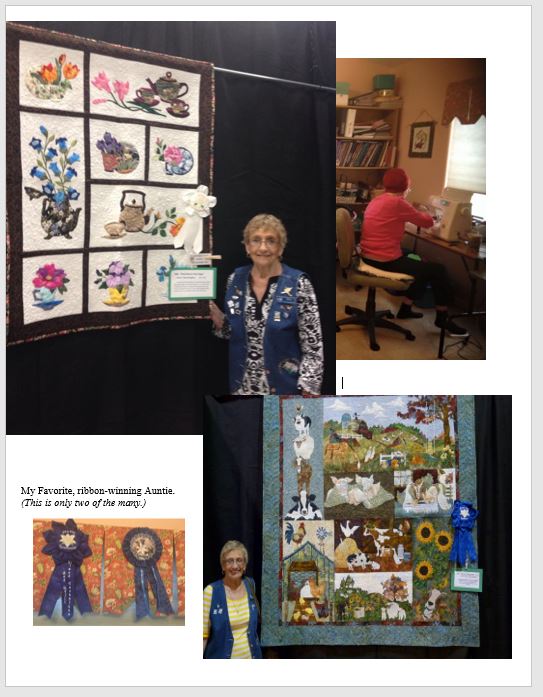
I am dedicating this Quilt Day to my favorite quilting Auntie, Nyla Stoughton.   
(She has not been able to quilt for many months due to health issues.)


Friday, March 1, 2019

Her Name Shall Be Called "MaMoo"

How many sewing machines do you actually need?  The truth is, ONE...and maybe a backup when that ONE is at the spa for an R & R .  Well, and maybe another one for guest sewers...and don't forget the Featherweight.  Everyone needs a Featherweight. And maybe just one more....

...the one your friend found in a thrift shop on her trip to Tahoe, and  brings it back for you.

Her Name Shall Be Called MaMoo (pronounced "Ma - MOO")


Singer 201-2


MaMoo was my Great Grandmother's nick name.  Mary Elizabeth Graff was the very first quilter in my life.

I can remember as a little girl spending weekends at MaMoo's house.  Her friends would come over and they'd sit around a big quilting frame set up in the dining room and quilt and gossip.  I'd sit under the frame and just watch the needles moving in-and-out (and listen to all the gossip.)

All In The Family
Happy Birthday to Me!  (March is my birthday month.)

Yes, I do have five sewing machines!  It's like a sickness....
Miss Ellie is my traveling companion.
Millie and I spend the most time together.
The Twins are for guest sewers (we have a group that meets once a week.)
Now we have The G-Ma...pulling the family together.

Sunday, February 24, 2019

Getting Started Series - Squaring Up Your Fabric

When I was in Middle School...sometime in the dark ages...every girl had Home Ec classes, both sewing and cooking. In those days our sewing projects were garments.   When constructing a garment we had to be very mindful of placing our pattern on the straight of grain. If you didn't, your garment would not hang straight on your body. (My childhood friends on Facebook and I still talk about that Home Ec teacher...she was a doozie! She tortured us with darts, zippers and set-in sleeves! These were my earliest dates with Jack...Jack the ripper.)

 
With quilting, we don't pay a lot of attention to the straight of grain (or the weft and the warp), but we are very mindful of the "square" of the fabric.  If your fabric isn't square, your blocks will be wonky (that is a quilting term meaning misshapen.) When you purchase a piece of fabric, you watch the sales person cut it off the bolt and it looks perfectly fine.  It isn't.  It is not "square" regardless of how straight everything looks.

A little rabbit trail here... Click HERE for a interesting video on how fabric is made. And then Click HERE for another short video on how it is wound on the bolt we see in the fabric store. It actually makes sense to me now why fabric isn't perfectly square on the bolt and why it is not perfectly square when it is cut.

There is nothing magical about this.  I don't have any "sure fire way" or words of wisdom about squaring up your fabric.  Instead, let's turn to the internet.  The Internet is a wonderful place to find EVERYTHING. (Recently I heard an interview with Luis Perez, an AAF football player, who said he learned to be a quarterback on YouTube!)  Well, I found two helpful internet sites, one a video (on YouTube) and one a  printed step-by-step tutorial on Blueprint (formerly Craftsy), where we will learn to square our fabric.

Here is the YouTube video.  It is quite good, but, she doesn't show you how to cut your fabric after squaring up. Here is the step-by-step tutorial on Blueprint. This tutorial fabric shows you step-by-step how to square up the fabric and also shows you how to cut the fabric.  (A note on the step-by-step; when working with yardage, don't unfold the entire piece and try to square it up....start at the end, leaving the remainder of the yardage folded.  You will need to continue to square up as you use up the yardage.)

OK, that's it for this Getting Started session.  And, if you decide to take up football, remember you can learn to be a quarterback on YouTube!


Thursday, February 14, 2019

Getting Started Series: A Few Words about Thread


There is really only one rule about thread....don't buy cheap stuff.  That is pretty much it.
The five-spools-for-a-dollar you sometimes find...  Leave them where you found them.

There is a lot of good thread on the market.  Personally I like Aurifil.  It is an Italian thread.  The main reason I like it is less lint in my sewing machine (and because my Quilting Auntie told me to use nothing but Aurifil.  I always do what I'm told.)

I found a very good article on choosing the right thread for any sewing project from sewing bathing suits to quilt piecing:
Click HERE.

Good thread will cost more, but it's worth it.  I buy mine right off Amazon; $10 a spool. (And, believe me, these spools last a L-O-N-G time.)


I have a drawer full of thread, but I tend to quilt piece with only a few colors: a very light blue, # 2600;  a beige, # 2000 and occasionally a medium gray # 2605.

My Bowl-O-Thread


Wednesday, January 30, 2019

Getting Started Series: To Stash or Not To Stash


I follow several quilting-related Facebook pages and I see a lot of posts about buying fabric "for my stash."

So, should you stash?  If you have the room, the money and the desire--YES!  Else, No.

I have a couple "serious" quilter friends who have ROOMS filled with fabric.  They know what they have (mostly), where it is (generally) AND they actually use their fabric stash (some.)  I'm impressed.  (I'm not naming any names, but you know who you are...)

Impressive Organization


I am at that stage in life where I understand that when I graduate to heaven my son is going to back a dumpster up to the house and pitch everything in.  I am trying VERY hard to NOT buy fabric if I don't have an immediate use for it...no matter how adorable or beautiful it might be.

My current stash consists of two hanging shoe organizers and I'm trying very hard to sew it up.

In the interest of full disclosure; this is only half.


There are some helpful blogs out on the internet if you are serious about building a stash.  Click HERE for one I liked.  As I read some of these blogs it occurred to me that I've never actually met anyone who built a stash by "formula."  It is usually by accident; "Oh Look!  I love it!  I must have it!"

The question of whether to Stash or Not To Stash is purely subjective.

Tuesday, January 29, 2019

Getting Started Series: All About Fabric

I LOVE fabric.  I know I'm not alone.  When my children were young I'd ask them "do you want to go to heaven?"
Then, off we'd go to the fabric shop.


There are so many talented people designing and producing so many beautiful fabrics;  it is impossible to name them all.  A few of my personal favorites:  Moda, Kaffee Fassett, Tula Pink, Grunge, Amy Butler, Robert Kaufman.  The list is a long one.

I will say from the outset, for me this is the hardest part of making a quilt, choosing my fabric.  Just a couple days ago I spent over $100 on fabric for a baby quilt....got it home, then changed my mind!  I decided on an entirely different pattern, which means different fabrics. (Not all was lost, the fabrics I bought have been re-assigned to finish other quilts-in-process. And the new pattern will be completed with fat quarters, pieces and scraps I already have.)

Sorry to say, I cannot help you choose just the right fabric for your project.  But, here are a couple of tips for choosing "good" fabric.

*Learn to read the end of the bolt.

What you see:  The manufacturer, the designer (usually), fabric line name, fabric dimensions, fabric content, care instructions and price.  For quilting we are usually looking for 100% cotton.

The fabric selvage also has helpful information. (The selvage is the tightly woven edge of a fabric. It prevents the side edges of the fabric from raveling or fraying. Don't use the selvage in your project!)

 
The Selvage will show the designer, name of fabric and a color code.  I use to think this color code was used for coordinating fabrics.  As in, choose other fabric colors that match this code.  Actually it shows the order in which the color was added to this fabric.  (Between you and me and the fence post, I do still use it to pick coordinating fabrics.)

One last word on selvages.  Save them; at least until your project is finished.  On more than one occasion I've run short of a particular fabric and had to hunt the internet to find more.  It sure helps if you know the designer, fabric line and color. (Some creative people use them to make all manner of items, search Pinterest.)


*Get to know your local, independent fabric shops.  Spend time browsing and chatting up the sales people.  People who work in these shops are generally sewers of some type and probably LOVE fabric as much as you do.  They usually have lots of  displays and ideas (and classes!).  They will help you audition fabrics for your project.

* Buy quality.  I know some people will swear they buy "off brand" fabrics and never have any trouble with fading or shrinking...and I know other people who were really sorry.  That door swings both ways.  For me, I almost never buy fabric from a big-box store, unless it is for something like Christmas stockings or a project that will not be washed.

...that brings to mind the age-old question:  "To wash, or not to wash..." your fabrics before use.  Some people do and some people don't.  I mostly don't when quilting, but I do when sewing garments. 

To get to know fabrics, designers and local quilt shops, look for an organized shop-hop.  Many areas have annual hops with prizes and give-aways.

This one is in Southern California Click HERE

If  you can't find an organized hop, make your own.  My fellow quilter, The Other Charlotte, and I have done several, all on our own.  One we did last year; we hopped from Spokane, WA down to Orange County, CA.  Click HERE.

I hope I was able to give you some useful ideas about fabric.

Happy sewing to all, and to all a good day!